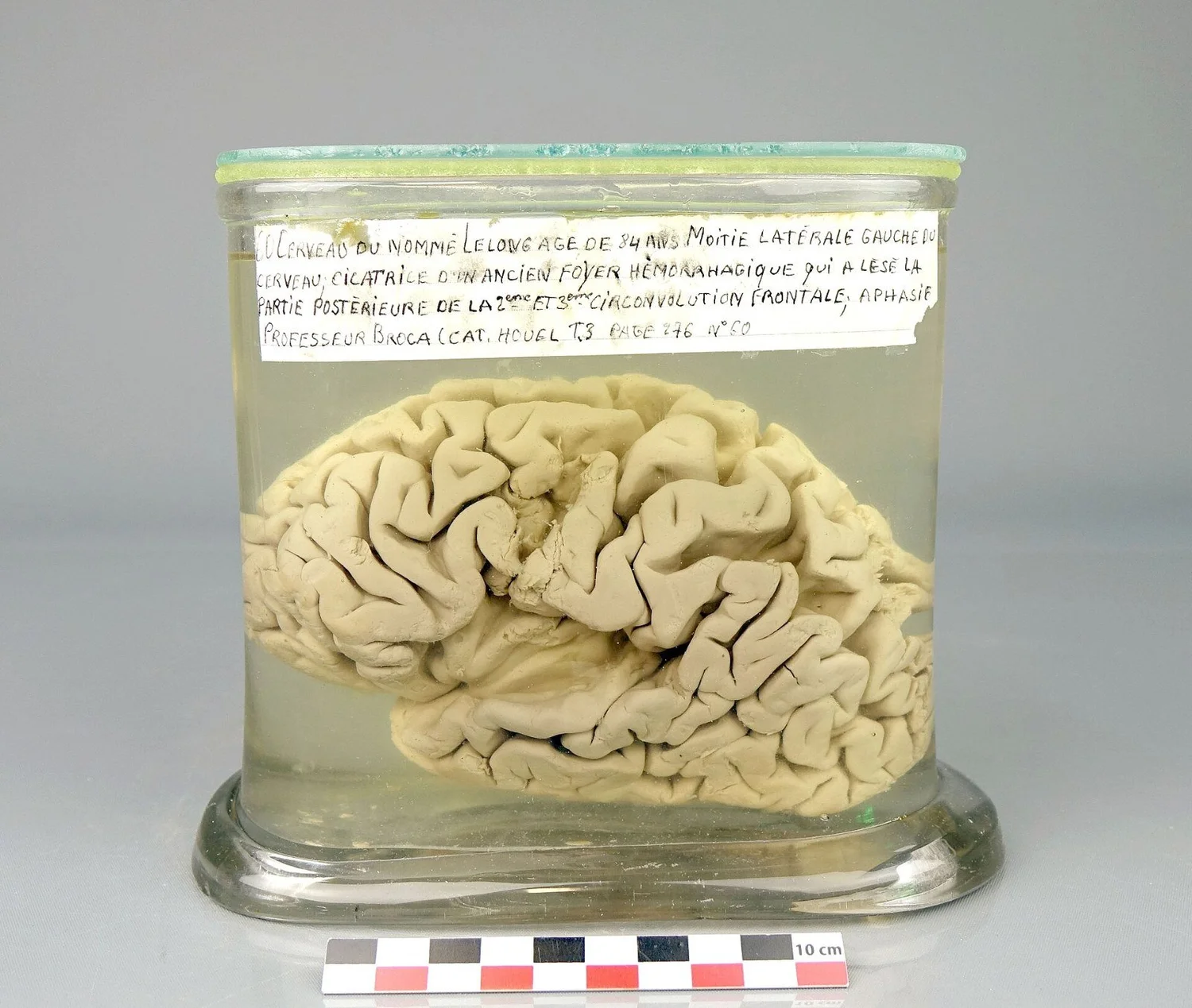
Cover: the left hemisphere of Lazare Lelong, Paul Broca's second aphasic patient (1861). Photo: Éloïse Quétel, Sorbonne Université, Licence Ouverte.
The Name He Could Not Say
Popper and Eccles asked how a conscious self can act on its brain. This essay asks a narrower question that a neurologist meets at the bedside. When a lesion changes how a person can speak, how does the physician recognize what that person is still trying to say? I argue that the answer is partly in the physician's hands. Popper's three worlds supply a vocabulary for keeping apart the lesion (World 1), the patient's experience of reaching for a word (World 2), and the public meaning that word carries, including the diagnosis itself (World 3). Eccles's interactionism keeps the relation between agency and physiology a serious question, but his proposed mechanism, the liaison brain and later the quantum modulation of vesicle release, is a speculative wager that clinical practice does not need and should not adopt, since it brings back the Cartesian picture that hermeneutic medicine has worked to dismantle.
The argument turns on post-stroke aphasia. Some patients report that a word is available inwardly while it cannot be said aloud, and experimental work partly supports these reports. In that gap the physician's conduct becomes evidential. Waiting, declining to finish the sentence, and offering another channel of response change what the patient is able to express, and so change what the physician can know. I call this the epistemic consequence of therapeutic tzimtzum. I then correct my own earlier use of tzimtzum as withdrawal, drawing on Wolfson's reading of Eibeschütz: if there is no place from which the divine withdraws, the physician's restraint cannot be a retreat but must be a form of staying present without grasping. Finally, I argue that a diagnosis, like a parable (mashal), can take possession of a patient's story, and that the patient must keep the power to correct the physician's reading.